
An operator’s view of what it takes to grow a senior home care business, and where AI actually earns its place.
Senior home care is one of the few industries where demand is guaranteed and growth is still hard. The reason is simple. Two flows never stop leaking. New clients arrive slower than they should, and caregivers walk out faster than anyone wants. Every other number in the business bends around those two. Marketing spend, margin, referral reputation, the owner’s sanity. All of it traces back to how well an agency wins clients and keeps caregivers. What follows is how I think about closing both gaps, and where AI helps rather than just adding another dashboard nobody checks.
The starting point
Start with the tailwind, because it matters. Ten thousand Americans turn 65 every day. By 2030 the entire baby boomer generation crosses that line, and roughly three in four older adults say they want to stay in their own homes rather than move into a facility. The U.S. home care market has grown from around $77 billion in 2020 to well over $110 billion today, with no sign of slowing. If you run an agency, you are not fighting for scraps. You are standing in front of a rising tide.
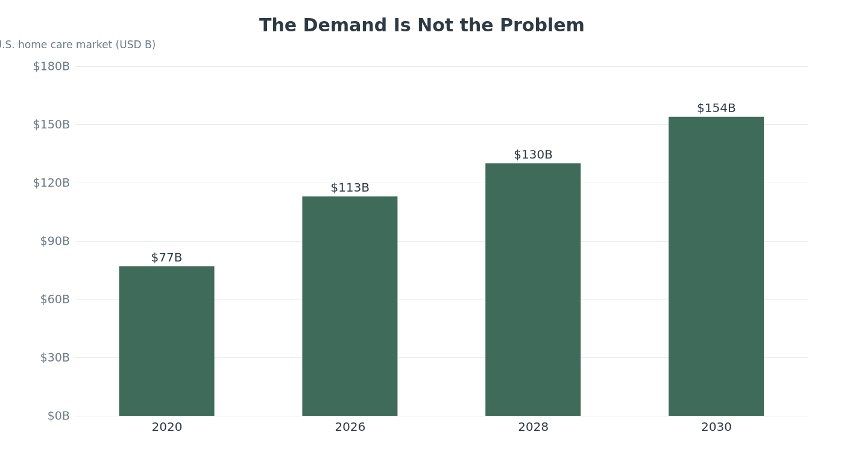
U.S. home care market size, selected years. Growth is steady and demographic, not cyclical. Sources below.
So why do most agencies struggle to grow? Because demand is not the constraint. Capacity is. And capacity is a function of the two leaks.
Where the time is actually going
Before buying a single tool, measure two things honestly. How long it takes to respond to a new client inquiry, and how long a caregiver actually lasts. Most owners are surprised by both numbers. Families calling about care for an aging parent are anxious and ready to decide. If you call back the next day, they have often already signed with the agency that called back in an hour. On the other side, caregiver turnover has hovered between 75 and 79 percent for years, and nearly four out of five caregivers who leave do so within their first hundred days. The damage is concentrated in a narrow window, which is actually good news, because concentrated problems are the ones you can fix.
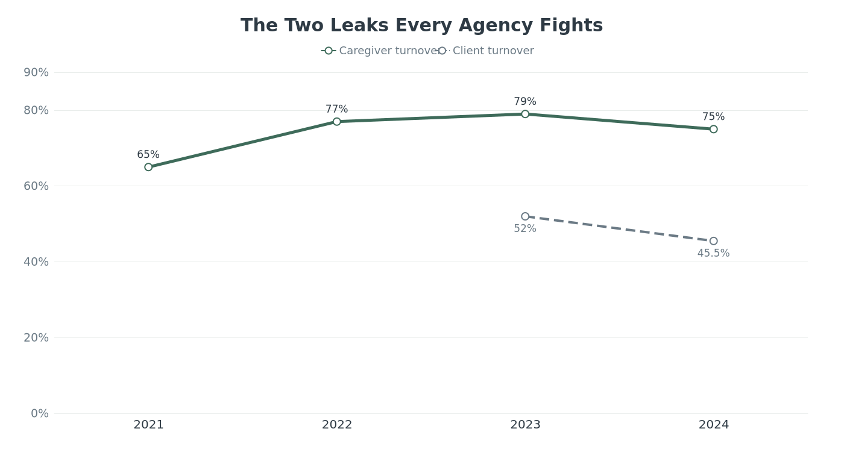
Caregiver and client turnover, 2021-2024. Caregiver churn eased slightly to 75%; client churn hit a seven-year low.
What tends not to work first
The instinct, when growth stalls, is to spend more on lead sources and job boards. Buy more client leads. Post more caregiver jobs. It feels like progress. It usually is not. Faster hiring from weak channels just feeds the churn machine. The industry hires most of its caregivers through job boards, and those are precisely the hires who leave fastest. Pouring more volume into a leaky funnel produces more people leaving, not more people staying. Chasing the top of the funnel before fixing the bottom is the most common and most expensive mistake I see.
Where AI actually helps
Here is the part everyone wants to talk about, so let me be precise about it. The fastest wins from AI are speed and consistency, not intelligence. An inquiry answered in minutes instead of hours changes whether a family chooses you, and AI can handle that first response around the clock without a coordinator glued to a phone. It can match a caregiver to a client based on skills, location, and temperament faster and more consistently than a rushed scheduler. It can watch the early-warning signals on a new hire, the missed shifts and the quiet disengagement, and flag someone drifting toward the exit before anyone notices. These are mechanical problems. Machines are genuinely good at mechanical problems.
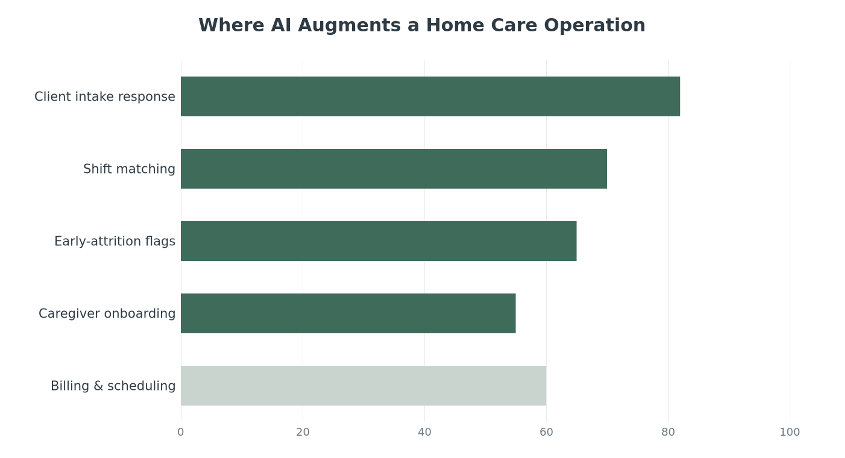
Where augmentation potential concentrates. Intake response and shift matching offer the fastest returns.
What AI cannot touch
Now the part fewer people say out loud. A tool does not calm an anxious daughter deciding on care for her mother at two in the morning. It does not make a caregiver feel genuinely seen after a brutal shift with a difficult client. It does not rebuild trust with a family after a scheduling mistake. Client acquisition and caregiver retention are, at their core, relationship problems, and relationships stay stubbornly human. The best thing AI does here is clear the administrative weight off your people so they have the time and energy for the part only people can do.
The human judgment that makes the tools work
There is a number that captures this perfectly. Caregivers hired through word of mouth turn over far less than those hired through job boards, and they cost less to bring on. No algorithm decides to build a word-of-mouth pipeline. A person does. A capable operator sets the hiring standard, cultivates the referral network, and defines what a genuinely good caregiver-client match looks like. The tools then enforce that judgment at scale and speed. Reverse the order, point automation at a broken process, and all you get is a faster broken process.
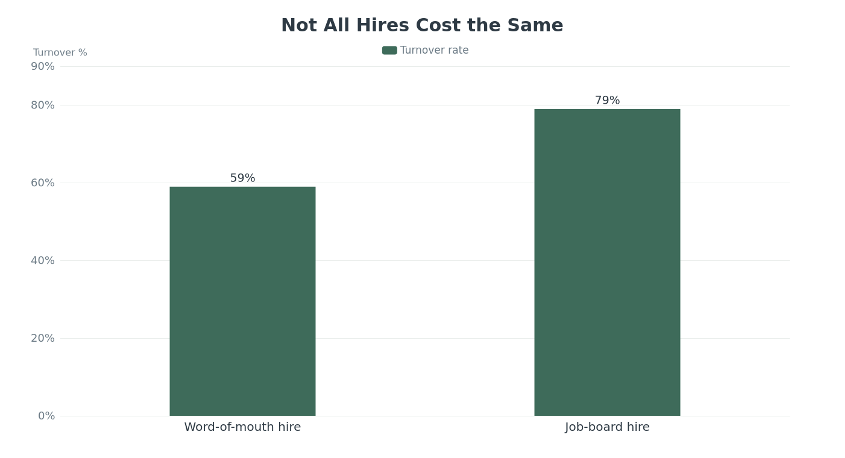
Word-of-mouth caregivers turn over at roughly 59% versus the ~79% industry average for job-board hires.
What I would do differently
If I were building or fixing an agency today, I would fix retention before spending a dollar on acquisition. A caregiver who stays a year is worth more than three who cycle through in ninety days, once you count recruiting cost, training time, lost continuity, and the client relationships that fray every time a familiar face disappears. I would start with the first hundred days. Onboarding, early check-ins, real supervisor contact, and automated early-warning flags for the hires who are quietly slipping. Only once that bucket holds water would I open the top of the funnel wider. The sequence matters more than the software.
The takeaway for operators
Client growth and caregiver retention are not two projects. They are the same project. An agency that answers fast, matches well, catches attrition early, and keeps its people close will grow almost in spite of itself, because reputation in this business travels by word of mouth and word of mouth rewards stability. AI is a real lever inside that system. It is also the smallest part of it. The judgment behind the tools, knowing which problem to solve first and which to leave to a human, is the whole game. Get the order right, point the technology at the mechanical work, and keep your people focused on the families and the caregivers. That is what it takes.
References
- Activated Insights 2025 Benchmarking Report — caregiver turnover ~75%, client turnover 45.5% (seven-year low)
- Home Health Care News — industry turnover history and hiring channels
- HHAeXchange — word-of-mouth hires show ~59% turnover and lower acquisition cost
- CARE Homecare — nearly 4 in 5 departing caregivers leave within first 100 days
- AveeCare — U.S. home care market size and 2030 projections; 10,000 turning 65 daily
- North American Community Hub — 2025 U.S. home care industry statistics