
Find a profitable company still running payroll off a spreadsheet or scheduling by hand, and the reflex is to assume the owner is behind the times. Sometimes that’s true. Usually it isn’t. Profitable companies keep manual processes because, for a long stretch, keeping them was the rational choice. The process worked. The person running it was cheap next to the cost of the fix. And the disruption of replacing it wasn’t worth the gain.
So the question worth asking is not why manual work is bad. It’s why it survives, and how to spot the moment its economics flip from sensible to expensive. That moment is the whole game, and most companies miss it by years.
The manual process is usually load-bearing, and that’s why it stays
The first reason it survives is simple. It works, and it’s woven into how the business actually runs. A manual process refined over a decade by the person who owns it is often more reliable than owners get credit for. It handles the edge cases. It absorbs the exceptions. It never throws an error the operator can’t fix by hand in thirty seconds.
Replacing it means replicating not just the clean path but every quirk nobody wrote down. The scheduling spreadsheet has fourteen years of judgment baked into it that the owner would struggle to explain and a vendor would never think to ask about. This is also why the cost of keeping it is so easy to undercount. Owners tend to price the manual process at the salary of the person doing it, and studies of service businesses put the true cost at three to five times that, once you add the errors, the rework, and the risk. The manual process persists because it is quietly doing more than anyone realizes.
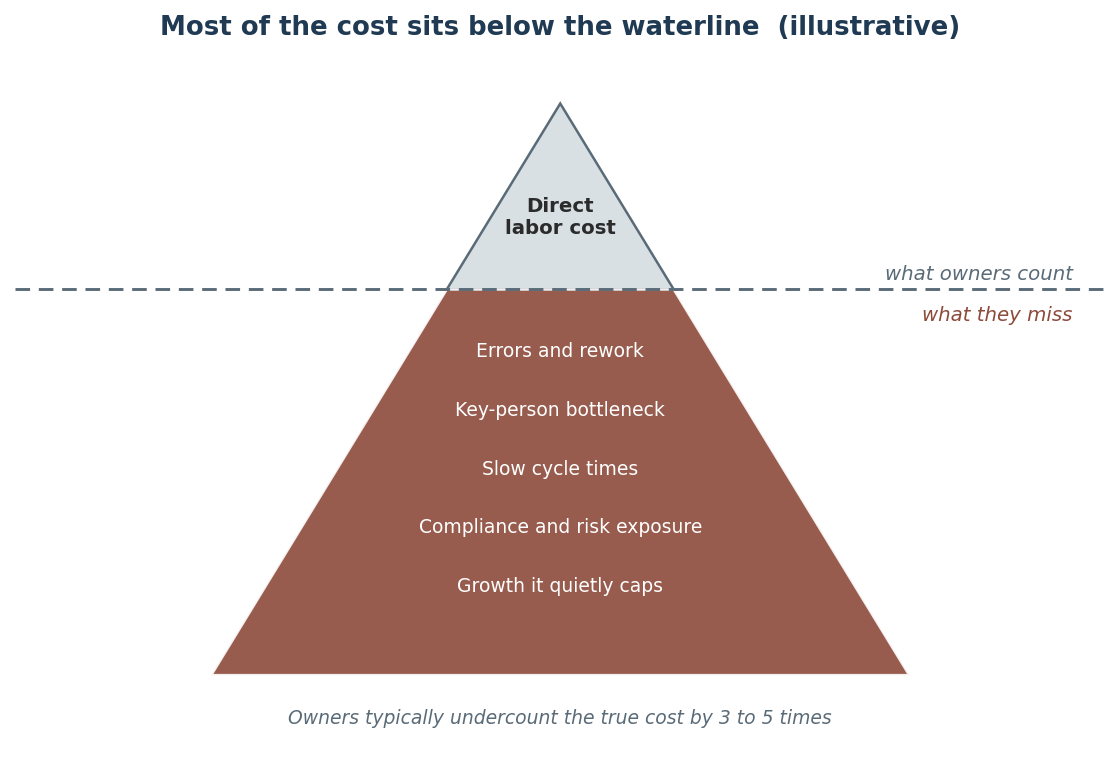
Figure 1. The direct labor cost is the part everyone sees. The rest sits below the waterline. Illustrative.
The economics that keep it alive, and why they’re real
Here is the honest case for leaving it manual, because you have to grant it before the turn means anything. At small scale, a person doing a task by hand is cheap, flexible, and low-risk. The software costs money. The implementation costs time. And the transition carries a real chance of breaking something that currently works fine.
For a business doing the task a few hundred times a month with one competent person, the payback math genuinely favors staying manual. The automated version has a higher fixed cost that only pays off once volume spreads it thin enough. Below that crossover, the manual line is simply lower. This isn’t inertia wearing the costume of reason. For a real stretch of a company’s life, staying manual is just correct, and an operator who automates too early is burning capital to solve a problem the business doesn’t have yet.
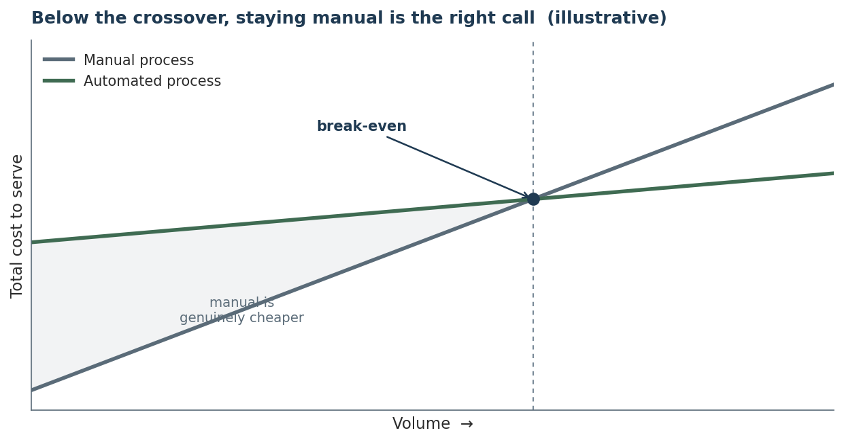
Figure 2. Manual carries a lower fixed cost, so below the crossover it genuinely wins. Illustrative.
The flip point: where the math quietly reverses
The economics reverse gradually, which is exactly why they get missed. No single day announces the change. Volume grows. The manual process starts eating more hours. The error rate creeps up because the person is now rushing. That one person becomes both a bottleneck and a risk, since the whole thing lives in their head and they take vacations and eventually leave.
The trap is that the cost of staying manual stops being the salary of the person doing it and becomes the growth it’s now capping and the risk it’s now carrying. Neither of those has ever appeared on a line item. Gartner pegs the drag from operational inefficiency at 20 to 30 percent of revenue for a typical company, and almost none of it shows up where a P&L would flag it. The flip point is not when manual gets expensive. It’s when manual starts limiting what the business can do, and by then it has usually been the wrong answer for a while.
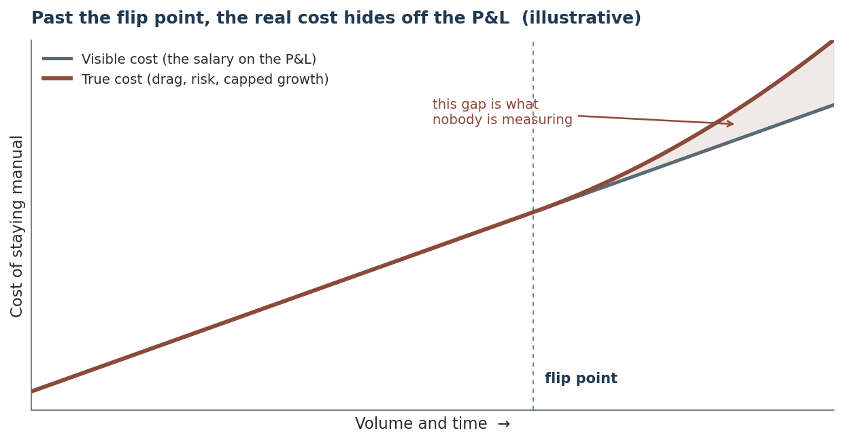
Figure 3. Past the flip point, the visible cost barely moves while the true cost pulls away. Illustrative.
Why even the flip point gets ignored
So the moment passes unnoticed, and the reasons are human rather than analytical. The person doing the manual work is often the one who would have to admit it’s time to replace it, and their job is wrapped up in it, so they won’t. The cost is invisible because it lives in opportunity and risk, not in an expense the bookkeeper can point to. And the fix looks like a project nobody has time to run while the business is busy growing, which is precisely when it matters most.
This is where an outside operator earns their keep. Someone new can see in a week what the incumbent normalized over years, because they haven’t spent a decade adapting to the workaround. It’s the same reason a new owner walks into an acquisition and spots the bottleneck the seller stopped noticing. Fresh eyes aren’t smarter. They just haven’t learned to stop seeing the problem.
Replacing it well, and where AI moved the line
Replacing a load-bearing manual process badly is worse than leaving it, so the method matters more than the urgency. Map what the process actually does, edge cases included, before you touch it. Replace it in pieces rather than all at once. And keep the person who ran it in the room, because they know where the bodies are buried and you need that knowledge before it walks out the door.
The current shift is that AI has moved the crossover. Work that was uneconomical to automate three years ago, the judgment-flavored, exception-heavy back-office tasks that broke rigid software, is now reachable, because agentic systems reason through exceptions instead of failing on them. That pulls the flip point earlier for a lot of businesses, and the smart pattern is hybrid, plain automation for the predictable steps and AI for the messy ones, with a person on the exceptions that carry real risk. The discipline hasn’t changed, though. Automating a broken manual process just gives you a broken automated one, faster and more expensively.
The cost that never shows up on the P&L
Manual back-office work survives because for a long time it deserved to, and it persists past that point because the cost of keeping it never appears where anyone is looking. The skill is not a bias toward automation. It’s the judgment to see when a process that was the right answer became the wrong one, and the discipline to replace it without breaking what worked.
In a business you’re running or evaluating, the manual processes are not the problem. The one everybody stopped questioning is.
References
- CoreiBytes, True Cost of Manual Operations: ROI Calculator (2026) — owners undercount true cost by 3-5x; Gartner 20-30% inefficiency figure. https://blog.coreibytes.com/blog/true-cost-manual-operations-roi-calculator
- Stampli, The High Costs of an Inefficient Back Office (2026) — AP automation savings and hidden back-office drag. https://www.stampli.com/blog/accounts-payable/inefficient-back-office/
- US Tech Automations, Small Business Automation ROI (2026) — manual-process cost and automation payback math. https://ustechautomations.com/resources/blog/roi-of-automation-for-small-business-cost-breakdown-2026
- Creative Planning, Back-Office Optimization for Small Businesses in 2026 — back office as overhead vs. growth driver. https://creativeplanning.com/insights/consulting/back-office-optimization-small-business/
- Datarmatics, Agentic AI Workflows: How to Automate Business Processes in 2026 — RPA for deterministic steps, agents for exceptions. https://datarmatics.com/agentic-ai-workflows-business-automation-2026/
- Tungsten Automation, Agentic AI for Enterprise Workflow Automation (2026) — reasoning through variation and exceptions. https://www.tungstenautomation.de/blog/agentic-ai-in-enterprise-workflow-automation-guide-2026
- Second Talent, AI Agents Statistics for 2026 — 40-60% workflow-cost reduction as agents handle exceptions. https://www.secondtalent.com/resources/ai-agents-statistics/