
The return is mostly decided on the day you buy. The operating work just collects it.
Everyone treats the exit as the moment value gets created. The sale closes, the multiple prints, the return is real. It makes for a clean story, and it is mostly wrong. By the time an operator is preparing to sell, the decisions that set the multiple are years behind them.
Take a 3.5x on a lower mid-market services business. That return was mostly decided at entry, in what got bought and what the buyer saw in it that the price did not reflect. The two years of operating work that followed were real and hard, but they were collecting a return the entry had made possible, not manufacturing one from nothing. Working backward from the exit to the entry is the sequence that actually teaches you something, so that is the direction worth reading it in.
The multiple was in the gap between price and potential
Start at the exit and walk back to the purchase. A 3.5x does not come from a business that was already priced for its potential. It comes from buying something the market underpriced, usually because the potential was not visible to a generalist buyer. The lower mid-market is full of these, which is part of why the smallest deals have historically outperformed. Platforms in the ten-to-twenty-five-million range have entered around 5.9x EBITDA against 10x at the larger end, and the segment has returned a pooled 39 percent gross IRR since 2009, ahead of every larger band.
The typical entry thesis for a 3.5x is an operationally fixable business, margins sitting below where they could be, priced as if that gap did not exist. Working backward, the return is set by the distance between what you pay and what you can credibly get to. That distance is an entry decision. Nothing you do in year two widens it.
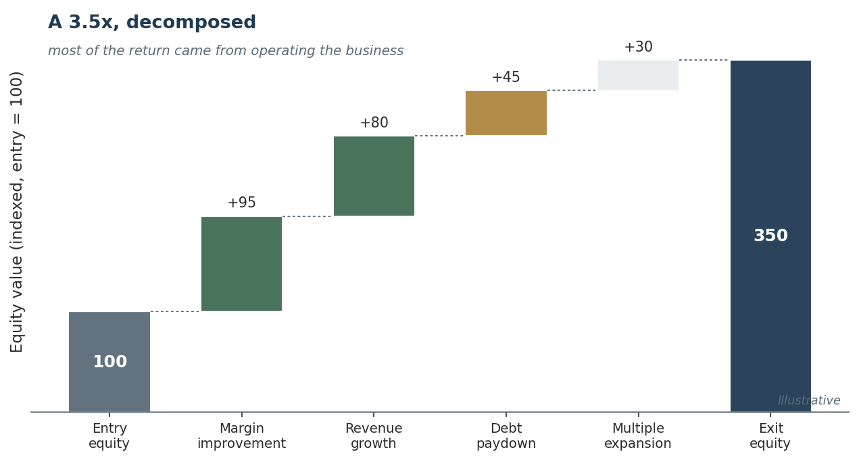
Figure 1. Decomposing a 3.5x. The operating levers, not the repricing, carry most of the return. Illustrative.
You underwrite the operating plan, not the business
Buying an underperforming business is only smart if you can name, before you close, the specific operating changes that close the gap, and believe you can execute them. “Healthcare is good” is not a thesis. “Rebuild the sales process, replace the manual systems, fix the management layer” is a thesis, because each item is a lever with a number attached and an owner assigned.
This is where the market has moved, and moved hard. Leverage and multiple expansion together drove roughly 59 percent of private equity returns between 2010 and 2022, and that engine is gone. The consensus now, from Apollo to Bain, is that value has to be underwritten, resourced, and executed from entry, not discovered along the way. Working backward from a good exit, every dollar traces to a lever someone identified before close. If you cannot write that list before you buy, you are not underwriting a return. You are hoping for one.
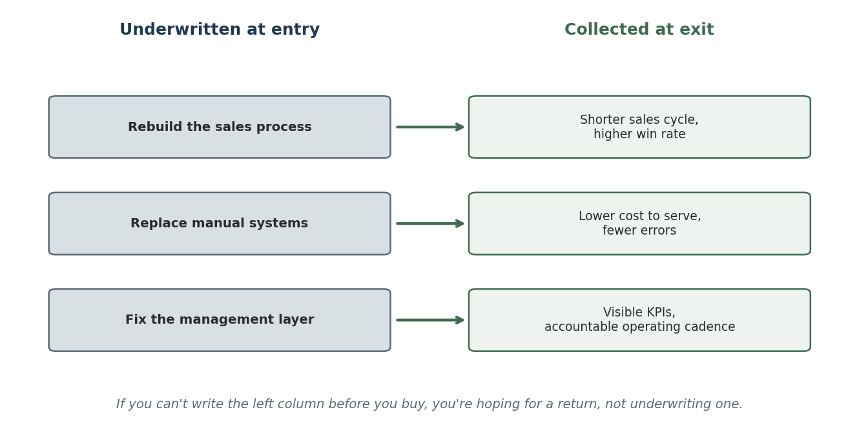
Figure 2. The entry thesis is a list of levers mapped to outcomes. The exit is that list, collected.
The diligence that mattered was operational, not financial
The financial diligence confirms the business is what the seller says it is. A clean quality-of-earnings review tells you the past was real. Useful, and not remotely sufficient, because it says nothing about whether your plan survives contact with the actual business.
The diligence that protects the exit is operational, and it happens at entry. Who actually holds the business together. Which of the fixes are real and which are wishful. What breaks the moment ownership changes. A 3.5x is protected by questions asked before close about whether the operating thesis was executable, not by the financial model that assumed it was. The buyers who consistently hit these returns are the ones who underwrote the operating plan with the same rigor everyone else reserves for the QoE.
Time is the hidden term in the multiple
A 3.5x in two years and a 3.5x in six are not the same return, and the entry decision that governs the difference is how fast the operating plan can realistically move. The multiple is time-blind. The actual return is not. Double your money in two years and you have made roughly 41 percent a year. Take six years to do it and you have made about twelve.
So part of underwriting the entry is being honest about velocity, how quickly you can rebuild a sales process or replace a system without breaking the business while you do it. Top-quartile firms now track speed of value creation explicitly, often measuring the EBITDA gains they capture in the first hundred days. When margins move fast, it is because the plan was sequenced for speed at entry, not because speed showed up as a happy accident. The pace of the exit was set by how the first ninety days were planned before anyone signed.
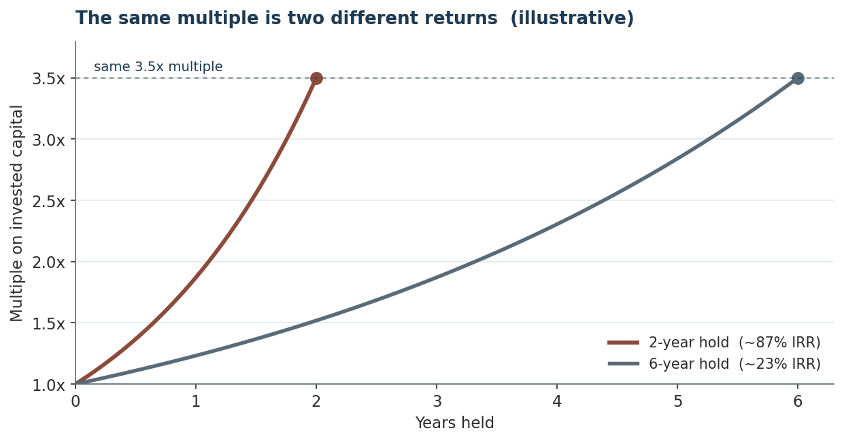
Figure 3. Same multiple, two speeds, very different returns. Velocity is underwritten at entry. Illustrative.
Where AI changes the entry math now
Here is what has shifted since the deals that produced the last cycle of these returns. The operating levers that drive a services-business turnaround, the call analysis that rebuilds a sales cycle, the workflows that replace manual back-office systems, are cheaper and faster to deploy than they were even two years ago. That changes entry underwriting directly.
Improvements that used to be too slow or too costly to justify at a given price now clear the bar. Which means the gap between price and achievable potential is wider today for an operator who can actually execute the AI-enabled version of the plan. An entry thesis that looked marginal three years ago can pencil now, because the same margin improvement takes less time and less capital to capture. The catch is the one running through all of this. The wider gap only exists for someone who can tell a real operating lever from a demo, and who underwrites what they can execute rather than what a vendor promises.
The exit is an entry decision
A good exit looks like a story about selling well. It is almost always a story about buying right, and about seeing something the price did not. Working backward from a 3.5x, the through-line is that the return was underwritten at entry and collected through execution, and those two are the same skill pointed at opposite ends of the hold.
Whether you are buying the business or hired to run it, the discipline is identical. Know what the gap is. Know how you will close it. Know how fast. Then decide whether to commit, because by the time you are standing at the exit, every one of those questions has already been answered, for better or worse, by the version of you that walked in the door.
References
- CapitalPad, Lower Middle Market Private Equity Statistics (2026) — 5.9x vs 10x entry multiples; 39% pooled gross IRR since 2009. https://capitalpad.com/lower-middle-market-private-equity-statistics/
- Apollo Academy, Beyond the Middle Market (2026) — leverage + multiple expansion ~59% of returns 2010-2022; value underwritten from entry. https://www.apolloacademy.com/beyond-the-middle-market-private-equity-investing-for-a-more-demanding-regime/
- Align BA, The Lower Middle Market May Be Private Equity’s Best Opportunity in 2026 — buy rationally, create value operationally, prove with data. https://alignba.com/2026/06/17/the-lower-middle-market-may-be-private-equitys-best-opportunity-in-2026/
- CohnReznick, Private Equity Mid-Year 2026 Trend Report — returns driven by execution and operational improvement, not multiple expansion. https://www.cohnreznick.com/insights/private-equity-mid-year-2026-trend-report
- Clateway / PE Value Creation 2026 Playbook — top-quartile firms track speed of value creation and first-100-day EBITDA gains. https://news.clateway.com/private-equity-value-creation-2026-playbook-examples-43385.html
- Private Equity Bro, MOIC vs. IRR (2026) — a 2.0x in two years (~41% IRR) versus six years (~12% IRR); time as a term in the return. https://privateequitybro.com/moic-vs-irr-when-to-use-each-return-metric/
- CapitalPad, Private Equity Holding Periods Are Lengthening (2026) — Bain’s “12 is the new 5” and the hold-period return test. https://capitalpad.com/private-equity-holding-period-statistics/