
A post-close playbook for the period that decides whether value gets created or quietly destroyed.
Most people assume the first 90 days after a deal closes are about making changes. The best operators know it is mostly the opposite. The early period is won by how much you protect, not how much you disrupt. You bought the business because it works. The fastest way to lose what you paid for is to walk in on day one and start rearranging it before you understand why it works. What follows is how I approach the post-close window, and why restraint, sequencing, and visibility beat action every time.
Why the first 90 days carry outsized weight
The deal thesis is not what makes or breaks the return. Execution after close is. Study after study lands in the same place. Most acquisitions that disappoint did not fail because someone bought the wrong company. They failed because the integration went badly, the culture was mishandled, or the key people left. Overpaying and weak diligence matter, but the factors that destroy the most value are the ones that play out after the wire clears, which means they are the ones you can still control.

Leading causes cited in failed deals. The largest are post-close execution factors, not the price paid. Sources below.
Before you touch anything, listen
The first few weeks are for listening, not directing. Sit with the people who actually run the place. Talk to the customers who generate the revenue. Read the numbers behind the numbers, not the ones in the CIM but the ones the controller keeps in a spreadsheet nobody shows buyers. The goal is a verified baseline. What is true, what is fragile, and what the previous owner knew that never made it into a document. You cannot improve a system you do not understand, and thirty days of genuine listening saves a year of undoing hasty moves.
Protect what already works
Every business has load-bearing walls. The salesperson who owns the top three accounts by relationship. The operations manager everyone actually calls when something breaks. The quiet supplier arrangement that keeps margins where they are. Your first job is to identify those walls and leave them standing. Sellers watch this closely, and for good reason. They are handing over something they built, and the fastest way to lose their trust and their people is to knock down a wall you did not know was holding up the roof.
Stabilize the team before you change it
A sale is one of the most destabilizing events an employee experiences. Uncertainty about their role, their manager, and their future pushes the strongest people, the ones with options, toward the door first. The numbers here are stark. Turnover at acquired companies runs several times the normal rate, and much of the damage happens early. The org chart can wait. In the first 90 days, re-recruit the people who make the business worth owning. Tell them where they fit. Silence is the most expensive thing you can offer in this window.
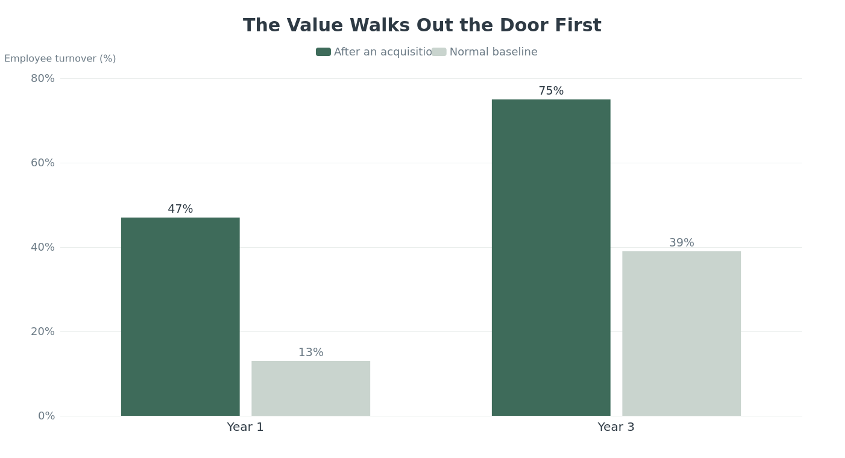
Employee turnover after an acquisition versus a normal baseline. The people you most need are the ones most likely to leave.
Find the cash and the constraints
With the team steady, turn to the operation. Two questions matter most early. Where is cash actually tied up, and what is the real constraint on growth. Not the one management assumes, the one the data reveals. In most lower mid-market businesses, cash hides in working capital and the growth ceiling sits in one specific place, a bottleneck in fulfillment, a gap in the sales process, a manual workflow that quietly caps volume. Find that one constraint and you have found the highest-leverage work of the entire hold period.
Sequence the changes, don’t stack them
Here is where most first-time owners go wrong. They see ten things to fix and try to fix them at once. The organization, already anxious, seizes up. Disciplined operators sequence. Listen and protect first. Stabilize the team next. Diagnose cash and constraints while that settles. Build visibility. Only then start changing things, one deliberate move at a time, each with a named owner and a clear target. The sequence is the skill. Stacking changes is how you turn a healthy business into a confused one.
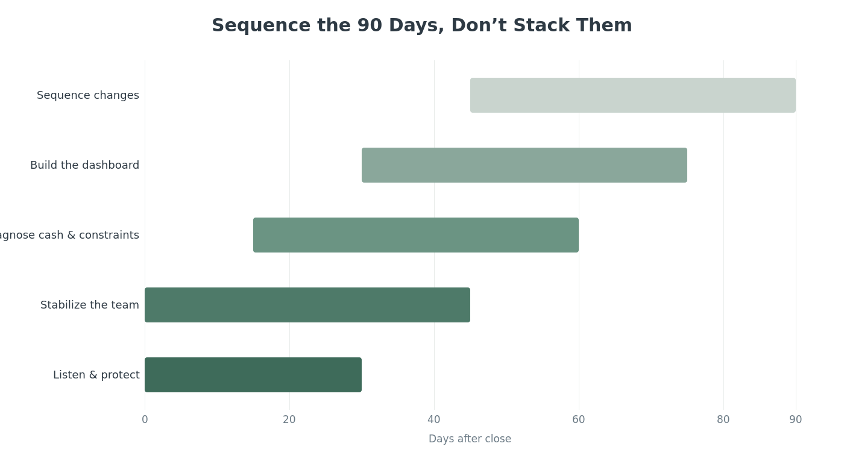
The phases overlap but do not start together. Each one earns the right to begin the next.
Build the dashboard before the strategy
You cannot manage what you cannot see, and most acquired businesses run on instinct and informal process rather than visible metrics. Before launching any grand strategy, install the operating cadence. A short set of the numbers that actually predict performance, reviewed on a fixed rhythm, with clear ownership. This is unglamorous and it is the single highest-return thing you do early. Decisions built on a real dashboard beat decisions built on the last conversation you had in the hallway, every time.
Where AI and automation fit, and where they wait
Modern operators have a lever earlier owners did not. AI and automation can take real cost and delay out of a business, especially in finance, back-office, and sales operations where manual work quietly drags on margin. But in the first 90 days, the move is to watch, not to automate. Point automation at a process you do not yet understand and you harden a broken workflow into place. Map first. Stabilize first. Then, once you can see clearly, use these tools to remove the mechanical drag so your people can focus on the work only people can do.
What the first 90 days are really for
The post-close window is not about exercising authority. It is about earning the right to lead. You earn it by protecting what works, steadying the people, seeing the business clearly, and moving in a sequence the organization can absorb. Do that, and by day 90 you have something more valuable than a list of changes. You have a team that trusts you, a clear view of where the value is, and the credibility to go get it. That is what the first 90 days are for. Everything good in the hold period is built on them.
References
- TriVista — Private Equity Value Creation: The First 100 Days
- Stanton Chase — What the First 100 Days Decide for PE Portfolio Companies
- Dr. Michelle Rozen — retention data; acquired vs. baseline turnover (MIT Sloan, HBR)
- PMI Stack — 50+ Post-Merger Integration Statistics (2026)
- Acquisition Stars — M&A Failure Rate and causes of deal failure
- Growth Shuttle — The 100-Day Value Creation Plan: An Operator’s Playbook