
An independent sponsor and a turnaround operator do the same work. The difference is who’s holding the risk.
Two people walk into the same underperforming business. One bought it. One was hired to fix it. Strip away the ownership paperwork and their first ninety days look nearly identical. Same diagnosis, same levers, same uncomfortable conversations with the same management team. I have walked into that business from both doors, and the resemblance is hard to unsee once you have noticed it.
The independent sponsor and the turnaround operator are running the same playbook from different seats. What separates them is not skill. It is who absorbs the loss if they are wrong. And it turns out each seat teaches something the other one cannot.
Same diagnosis, same first ninety days
Whichever door you came through, the opening move is the same. Find where the P&L is leaking. Figure out which problems are broken process and which are the wrong people. Decide what to fix first, because you cannot fix everything at once and pretending otherwise is how operators lose their first quarter.
Private equity has formalized this into the value creation plan, a structured read of where growth and margin will come from over the hold. A good turnaround operator brings the same discipline to a new mandate without calling it that. Neither person gets a slow ramp. Both are expected to know, fairly quickly, what is actually wrong and what they intend to do about it. The work rhymes because the problem underneath it is the same problem.
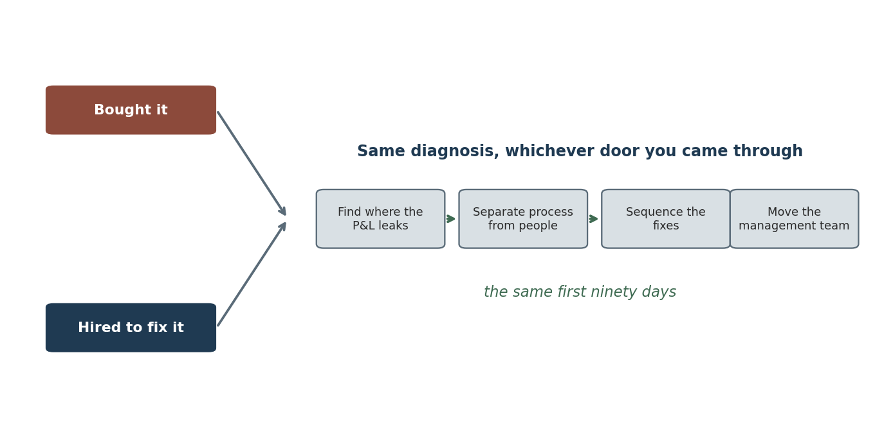
Figure 1. Two entry points, one diagnostic. The seat changes what’s at stake, not the first ninety days.
What the owner’s seat teaches: conviction has a price tag
When you have bought the business, every decision is priced in your own capital. You cannot write a recommendation and move on to the next engagement. You live with the call. That changes how you weigh risk, how patient you are willing to be, and how honestly you assess a problem you can no longer hand back to anyone.
This lesson matters more now than it did a decade ago. The way private equity makes money has shifted under everyone’s feet. Operational improvement and revenue growth drive roughly two-thirds of the value created in a typical deal today, where multiple expansion and cheap debt used to do most of that work. Owning the outcome, rather than structuring it, is where returns now live. So the owner’s judgment sits under real pressure. Ownership teaches you to think in years and to stare directly at the downside, because it is yours.
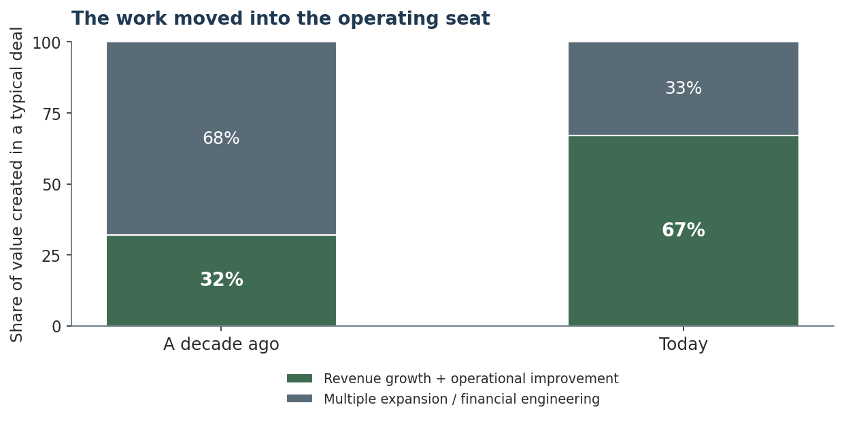
Figure 2. Value creation has moved from the deal structure to the operating seat. Sources: Finatal, A&M (2026).
What the hired seat teaches: no authority, only leverage
The operator’s lesson is harder to earn and easier to underrate. A hired fixer usually carries responsibility without ownership, and has to move a management team that did not choose them and may resent the intrusion. There is no equity to point to, no founder’s mandate. There is only the work of getting a room to move when you cannot simply tell it to.
You learn to build consensus without the title. You learn to read what actually motivates each person rather than what they say in the meeting. You learn to route around the org chart when the org chart is the obstacle. This skill is invisible right up until the moment you do not have it. Owners who have never operated without formal authority tend to overestimate how much authority accomplishes on its own. A title makes people comply. It does not make them care, and the fix usually needs them to care.
Where the two seats disagree, and who’s usually right
Put the same decision in front of both and they will often weigh it differently. Both distortions are real, and worth naming plainly.
The owner is prone to the sunk cost of their own thesis. They bought the business on a story, and a story is hard to abandon even when the numbers stop supporting it. They hold a bad bet too long because cutting it means admitting the thesis was wrong. The hired operator has the opposite failure mode. They optimize for the win that shows up inside their tenure and quietly skip the fix that only pays off after they are gone. One holds too long. The other builds too short. The best version of either role borrows the other’s discipline. The owner learns when to cut. The operator learns to build past their own horizon.
Why the overlap is growing
This is not just a tidy observation. The line between the two seats is genuinely blurring, and the market is pushing it that way. The independent sponsor model has grown from a fringe practice to a real segment of lower middle market dealmaking, with well over 1,500 active sponsors in the US, nearly double the count of five years ago, and a growing share of them are operators who got tired of fixing other people’s companies and started buying their own.
Private equity is pulling in the same direction from the other side. Longer holds and thinner financial-engineering returns have made operating capability the thing funds compete for, and demand for people who can run a post-close turnaround now outstrips supply. AI sharpens the trend further. The diagnostic work that used to need a team and a month, the data pull, the margin analysis, the first-cut operating model, increasingly takes one sharp operator and the right tools. When the cost of figuring out what is wrong drops, the distance between diagnosing a problem and owning it drops with it.
The same job, different risk
Whether you buy the problem or get hired to fix it, the work is the same work. Find the leak. Move the people. Build something better than what you walked into. The seat you sit in changes what is at stake, not what is required of you.
The operators worth knowing are the ones who have learned to think like an owner whether or not they hold the equity, and to build like a hired hand who knows the next person inherits the mess if they cut a corner. Both lessons come from the same place. You just have to sit in both seats to learn them.
References
- Finatal, How Operating Partners Are Redefining Value Creation (2026) — 65-70% of deal value now from operational improvement. https://finatal.com/north-america/operating-partners-value-creation-private-equity/
- Alvarez & Marsal, Private Equity Firms Turn to Operational Value Creation (2026) — margin improvement now the majority of EBITDA growth. https://www.alvarezandmarsal.com/press-release/private-equity-firms-turn-to-operational-value-creation-as-geopolitical-shocks-derail-deal-recovery
- H.I.G. Capital / WhiteHorse, A Lender’s Lens on the Independent Sponsor Market (2025) — 1,500+ active sponsors, nearly doubled in five years. https://hig.com/news/a-lenders-lens-on-the-independent-sponsor-market/
- Upstate Capital, The Rise of a Market: The Independent Sponsor Ecosystem (2025) — operators-turned-sponsors and deal-volume growth. https://upstatecapital.org/the-rise-of-a-market-the-independent-sponsor-ecosystem/
- notveryprivateequity, The Operator Supply Gap (2026) — demand for operating talent outstripping supply. https://www.notveryprivateequity.com/operating-partner-shortage/
- BDO, 2026 Private Equity Industry Predictions — longer holds and operating talent as core differentiator. https://www.bdo.com/insights/industries/private-equity/2026-private-equity-predictions
- CapitalPad, The Independent Sponsor Model: An Investor’s Guide (2026) — deal-first model and sponsor demographics. https://capitalpad.com/independent-sponsor-model/