
Not a team you trust. A structure explicit enough that trust isn’t the thing holding it together.
The standard advice for building a team that runs without you is to hire good people and trust them. That is roughly as useful as being told to win by scoring more points. True, and no help at all with the how.
The operators who actually pull it off do not rely on trust as the mechanism. They build a structure explicit enough that the operation keeps running whether or not anyone is feeling particularly trusting that week. Because here is the real problem. Most owner-operated businesses cannot function without the owner, and it is usually not because the team is weak. It is because the accountability lives in the owner’s head, and nobody else can see it. This is about getting it out of your head and onto something everyone can look at.
The real reason it doesn’t run without you
In most businesses, who owns what outcome is understood informally. It is carried in the owner’s memory and enforced by the owner noticing when something slips. That works fine, right up until the owner steps back, at which point ownership quietly evaporates, because it was never written down or made visible in the first place.
The failure is not delegation. It is that the accountability was never externalized. If you are the only one who knows who is responsible for what, then you are the system, and a system cannot run without itself. This is why the fix is never “trust them more.” You can trust people completely and still be the single point of failure, because trust does not tell a salesperson that retention is now theirs to defend. Structure does.
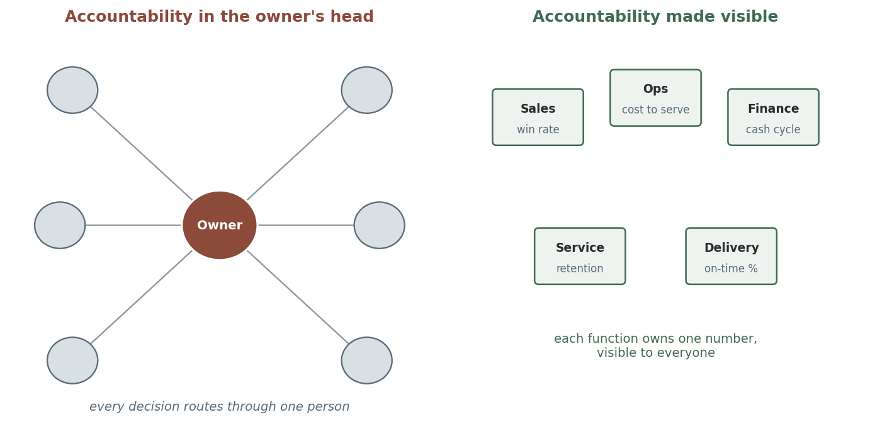
Figure 1. When every outcome routes through one person, that person is the system. Distributing and showing the ownership is the fix.
Every outcome needs one owner and one number
Vague shared responsibility is how things fall through the cracks. Each outcome that matters needs exactly one person accountable, not a committee, and one metric that tells that person and everyone else whether it is working. Two owners means no owner. A number without an owner is a report nobody acts on.
The discipline is unglamorous and it is the whole game. For every outcome you care about, name the single person and the single number, and make both visible to the entire team. The best framing I have seen puts it bluntly: every meaningful line in your P&L should have one, and only one, person accountable for it. That is also the real difference between delegating a task and delegating an outcome. Hand off a task and you still own the result. Hand off an outcome, with a number attached, and the ownership actually moves. This is what lets you check the operation without being in it.
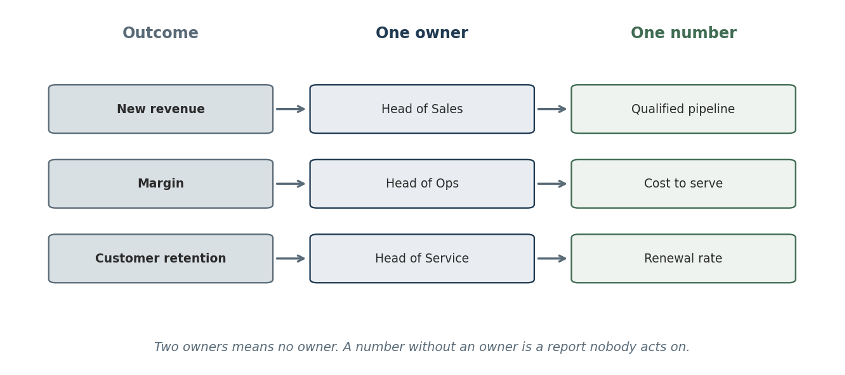
Figure 2. One outcome, one owner, one number. The mapping is what lets you step back without things going dark.
The operating cadence is the machine, not the meeting
Structure without rhythm is just a wall chart. The cadence, the regular review where owners report their number against target, is what keeps the structure alive. And it is not a status meeting where people narrate how busy they have been. It is a short, repeatable loop. Each owner shows their number, explains a miss, commits to a fix, and the whole group sees it happen.
The cadence does two things at once. It surfaces problems while they are still small, and it makes accountability social instead of dependent on you personally chasing people down. When the rhythm is real, the operation self-corrects between your check-ins, because nobody wants to show up to the same review with the same unexplained miss two weeks running. High-performing teams keep goals and accountability visible week after week, precisely so the answer to a slipping number is not “wait for the owner to notice.”
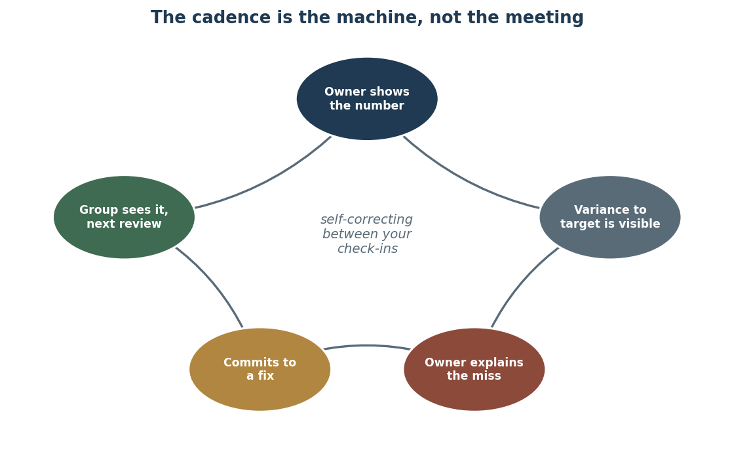
Figure 3. The cadence is a self-correcting loop, not a meeting. It catches problems while they’re cheap to fix.
Dashboards make it run without you, or make it worse
Visible numbers are the point, but a dashboard is only as good as the decisions it drives. A wall of forty metrics nobody acts on is theater. It looks rigorous and changes nothing, and it can be worse than no dashboard, because it inspires confidence in numbers that are not actually steering anything.
The discipline is ruthless subtraction. Usability research is consistent that comprehension and decision speed fall off sharply past roughly seven to nine metrics on a view, so a handful of numbers per owner, tied to the outcomes that matter, refreshed on a rhythm people trust. The test for any metric is simple. If you cannot name the specific action someone would take based on it, cut it. A good dashboard answers one question, who needs to do what differently this week. If it does not answer that, it is decoration, and you are back to being the only one who knows what to do about the numbers.
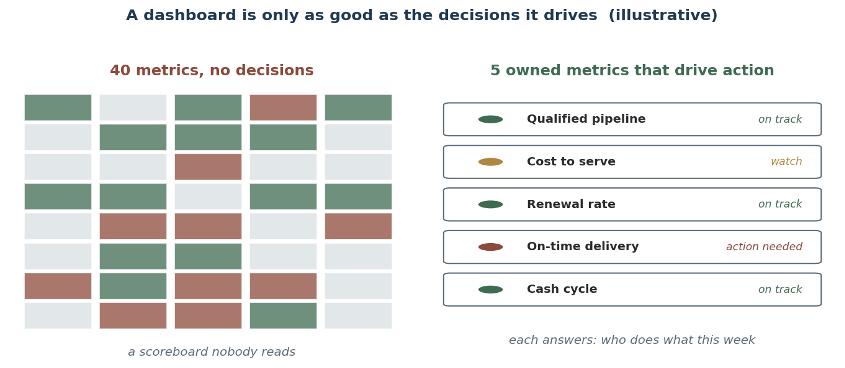
Figure 4. Fewer owned metrics that drive action beat a wall of numbers that drives none. Illustrative.
Where AI helps, and where it quietly removes the accountability
AI is genuinely good at the reporting layer now. It pulls the numbers, flags the variances, and surfaces the anomaly before the weekly review instead of after. That is real leverage, and it makes the cadence faster and sharper, since owners walk in already knowing what moved.
There is a trap specific to this topic, though. Automating the reporting can quietly remove the human ownership. If the dashboard simply tells everyone the number moved, and no single named person still owns the response, you have automated visibility and deleted accountability at the same time. That is a worse state than the manual version, because it feels modern while nobody is actually on the hook. So keep the design principle intact. AI should sharpen the owner’s judgment and buy back their time, not replace the fact that a named human owns the outcome and answers for it in the cadence. The tooling reports. A person still decides.
The test is whether you can leave
The test of a management layer is not how it performs while you are watching. It is what happens the week you are unreachable. A structure that runs without you is one where every outcome has an owner, every owner has a number, the cadence surfaces problems before they compound, and the dashboard drives decisions instead of decorating a wall.
Build that and you have done two things at once. You have made the business more valuable, because a company that does not depend on one person is worth more than one that does. And you have made yourself able to step back, which for anyone running more than one thing is not a luxury. It is the entire job.
References
- Strategy & Execution, Building an Owner-Independent Business (2026) — one accountable owner per P&L line; delegating outcomes vs. tasks. https://strategyandexecution.com.au/building-an-owner-independent-business-the-2026-strategy-for-scaling
- The Alternative Board, Build a Management Structure That Lets Your Small Business Scale — role scorecards, decision rights, operating rhythm. https://www.thealternativeboard.com/blog/a-management-structure-that-lets-your-small-business-scale
- Planisware, Strategic Alignment Checklist 2026 — assign a single accountable owner and a KPI with a clear target to each objective. https://planisware.com/resources/strategic-planning-alignment/strategic-alignment-checklist-2026-drive-results-across
- datawireframe, How Many KPIs Should Be on a Dashboard — comprehension drops past 7-9 metrics; the actionability test. https://www.datawirefra.me/blog/how-many-kpis-on-a-dashboard
- DataDes, KPI Overload: When Too Many KPIs Slow Down Decisions — scoreboard vs. decision system; outcome, drivers, context. https://datades.net/gd-kpi-overload/
- Randstad, From KPI Overload to Clarity — dashboard fatigue and the “if it doesn’t lead to an action, it doesn’t belong” rule. https://www.randstadusa.com/job-seeker/career-advice/career-development/dashboard-fatigue-financial-reporting-kpis/
- Improvado, What Is a KPI Dashboard (2026) — limit to 5-15 KPIs; more metrics create cognitive overload and inaction. https://improvado.io/blog/kpi-dashboard