
The interesting thing AI did to a services business wasn’t shrink the team. It changed the unit economics.
Almost every AI story in operations is a headcount story. Deploy the tool, cut the people, book the savings. It is the easy version, it is what a board wants to hear, and it mostly misses the point.
The more interesting thing AI does to a services business is change the unit economics. The cost to serve one customer, and the shape of what happens to margin as the business grows. A headcount cut is a one-time reduction in the cost base. Operating leverage is a permanent change in the slope of the business. This is about the second one, because it is the version that compounds, and it is the version most operators are underselling, since the cut is so much easier to put in a press release.
The difference between a cost cut and operating leverage
The whole argument rests on this distinction, so it is worth drawing sharply. A headcount cut lowers your cost base once. You spend less on Tuesday than you did on Monday, and then you are done. Operating leverage changes the relationship between revenue and cost, so that each new dollar of revenue costs less to serve than the last one did.
AI, deployed well, does the second thing. It takes work that used to scale one-for-one with volume and breaks that link. Traditional services businesses grow revenue by adding people, so serving twenty percent more customers meant roughly twenty percent more staff. When AI absorbs the repetitive middle of that work, the growth no longer requires the bodies. If your AI project’s only story is “we spend less now,” you captured the small version. The big version is “we can grow without our cost growing in step,” and those are different shapes, not different sizes of the same thing.
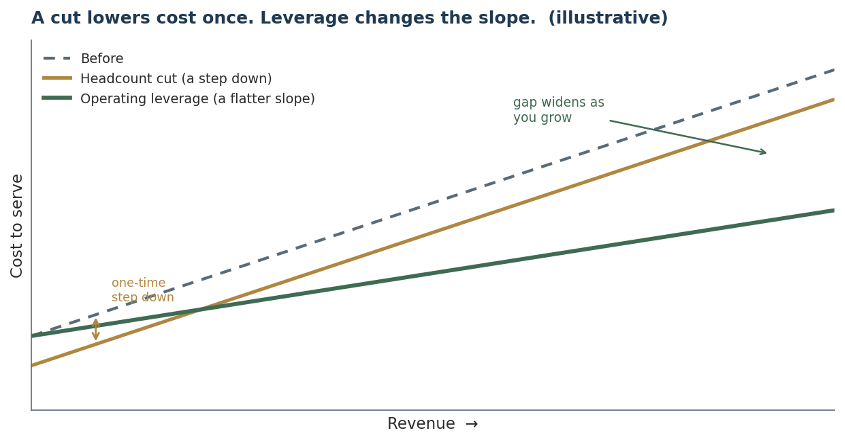
Figure 1. A cut shifts the cost line down once. Leverage tilts it. Over any growth horizon, the slope matters more. Illustrative.
What AI actually changed in the cost to serve
In a services business, cost to serve is mostly labor applied per customer. AI changes it in specific, nameable places. The sales cycle that used to need hours of human work per deal. The back-office task that scaled with transaction volume. The exception handling that used to pull in a person every single time. Each of those is a variable cost, and AI converts each one into something closer to a fixed cost, paid once rather than paid again for every customer.
What does not convert is the top of the work. The judgment, the relationship, the call that needs a human across the table. That stays variable and human, and it should. But when the repetitive layer beneath it stops scaling with volume, the per-customer cost drops, and the same team can serve a bigger book. That is a growth lever, not a severance line, and reading it as the latter is how operators leave most of the value on the table.
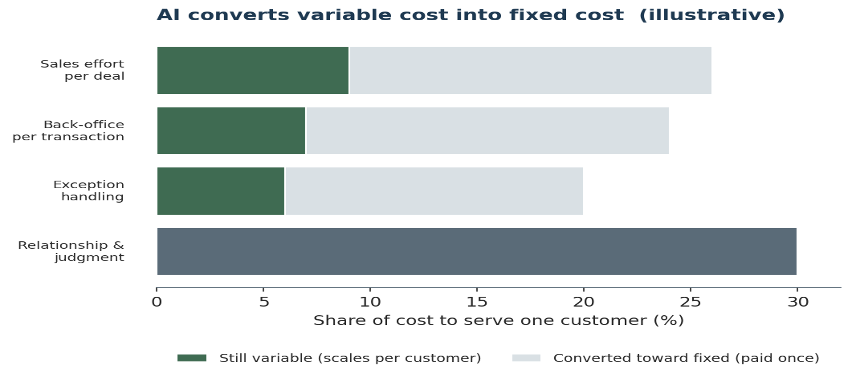
Figure 2. AI converts the repetitive layers from variable to fixed. The judgment layer stays human. Illustrative.
Why this shows up as growth capacity, not a smaller team
Here is where the honest version matters. Sometimes the cut is real. If the business is not growing, lowering cost to serve does free up people, and removing that cost can be the rational move. That is true, and it is also the smaller prize.
In a growing business, the rational response to a lower cost to serve is almost never to cut. It is to absorb more volume with the team you already have. The same headcount now supports a larger book, which is why the best AI operations stories tend not to feature layoffs at all. The people got redeployed to the work that grew, not shown the door. You can see it in the numbers coming out of AI-leveraged services firms, where revenue per employee has climbed well past traditional benchmarks while headcount stayed flat or grew slowly. When an AI story leads with the layoff, it is often a tell that the operator captured the cost cut and missed the leverage that was sitting right next to it.
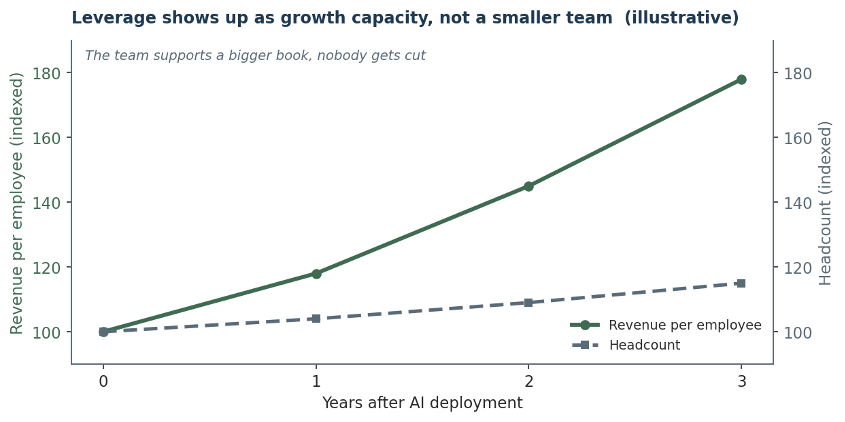
Figure 3. Leverage shows up as rising revenue per employee, not a shrinking payroll. Illustrative.
The margin math the layoffs story misses
Line the two up over a growth period and the difference is stark. A one-time cost cut improves margin once, on day one, and then the line goes flat. Operating leverage improves margin every time you add revenue, because the incremental cost of the next customer is lower than the last. The cut looks bigger the morning you announce it. The leverage pulls decisively ahead by the end of the first year and never looks back.
This is the part that matters for anyone valuing the business, and the market knows it. A structural change in unit economics is worth far more than a one-time expense reduction, because it changes every future period, not just the current one. A buyer pays a multiple for a business whose margins expand as it grows. They pay a much smaller premium, if any, for a business that simply spent less once. Same AI, same year, two completely different stories about what the business is now worth.
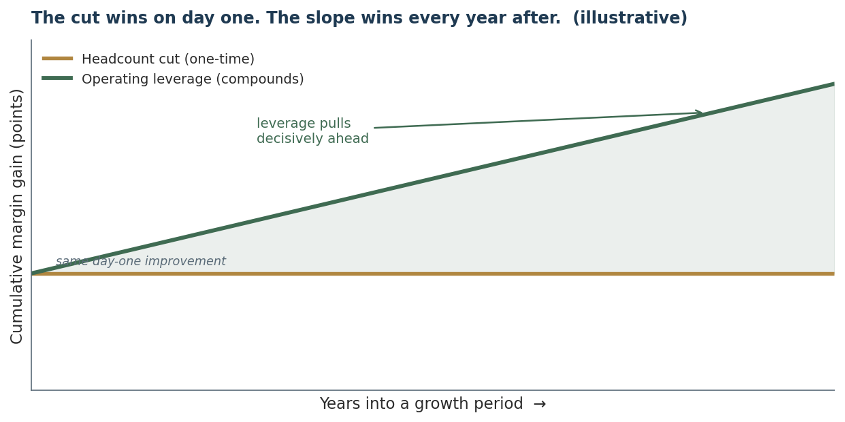
Figure 4. The cut wins on day one. The slope wins every year after. Illustrative.
Where the leverage is real and where it’s a story
None of this is automatic, and claiming leverage does not create it. The leverage is real only when the AI genuinely breaks the link between volume and cost, and it is durable only if it does not quietly create a new bottleneck somewhere else. More exceptions to review. More oversight of the model’s output. More rework when it gets things subtly wrong. The discipline is checking whether the cost actually became fixed or just moved to a different line where nobody is watching it yet.
And the operators who reach for the layoff first often destroy the leverage they could have had, by cutting the very capacity they would have needed to grow into. Real operating leverage is a design choice made at deployment, not an automatic property of buying the tool. You get it by aiming the AI at the work that scales with volume, keeping the people who do the work that does not, and pointing the freed capacity at growth. Miss any of those and you are back to a cost cut wearing a more sophisticated name.
The slope, not the step
A headcount cut is a step down in cost. Visible, one-time, easy to announce. Operating leverage is a change in slope. Quieter, compounding, and worth far more over any real growth horizon. The operators who understand AI as leverage rather than as a way to shrink the payroll are building businesses that get more profitable as they grow, not just cheaper once.
So in a business you are running or evaluating, the question is not how many people the AI let you cut. That is the small question, and it has a small answer. The real one is whether it changed the shape of the curve.
References
- Havlek, The AI Operating Leverage (2026) — human effort per unit stops scaling; growth absorbed by the existing team. https://havlek.ca/posts/2026-04-16-ai-operating-leverage-business-doing-more-with-less.html
- Forbes Finance Council, How AI Is Reshaping the Economics of Services Businesses (2026) — traditional services grow revenue by adding people. https://www.forbes.com/councils/forbesfinancecouncil/2026/08/06/how-ai-is-reshaping-the-economics-of-services-businesses/
- RiffOn, AI Enables Software-Like Margins by Decoupling Revenue Growth from Headcount — revenue per employee of $500K-$5M vs ~$400K software average. https://riffon.com/insight/ins_n89br5c5bky9
- The SaaS CFO, ARR per Employee Benchmarks (2026) — revenue per employee as a test of structural leverage vs. headcount dependence. https://www.thesaascfo.com/arr-per-employee-benchmarks/
- digitalapplied, AI Unit Economics: Pricing & Margins for AI Services (2026) — unit economics that fail at small scale don’t get rescued by volume. https://www.digitalapplied.com/blog/ai-unit-economics-pricing-margins-services-2026-framework
- surveil.co, AI Unit Economics FAQ — measuring AI unit margin and cost per dollar of profit. https://surveil.co/ai-unit-economics-finops-cost-value-margin/
- Rize, AI Spending Per Employee Benchmark (2026) — professional and business services lead AI spend per employee. https://rize.io/blog/ai-spending-per-employee-benchmark